- What Does the "Speed Regulation" Warning Actually Mean?
- Types of Speed Governors: From Flyweights to Firmware
- How Modern Generator Speed Control Fits Together
- Common Faults in Modern ECU-Based Speed Control
- Basic Troubleshooting: Eight Steps Any Engineer Can Do First
- Advanced Troubleshooting: CAN Bus & ECU-Level Diagnosis
What Does the "Speed Regulation" Warning Actually Mean?
You’re standing in a plant room, an engine room, or watching a remote monitoring screen, and a yellow or red alarm reads “Speed Regulation” or “Wrn SpdRegLim”. The engine might be surging rhythmically — called hunting — or it might have quietly lost a few rpm under load without recovering. Either way, this alarm is one of the most important warnings your generator controller will ever issue.
In plain terms, the Speed Regulation warning fires when the governor controller’s output — the command it sends to increase or decrease fuel — has hit its physical limit and the engine still hasn’t reached the demanded speed. Think of it as the controller shouting: “I’m doing everything I can and it’s still not enough.”
On a ComAp InteliGen controller, this appears as Wrn SpdRegLim. It means the speed regulator output has been clamped at maximum for longer than the configured time threshold without the engine recovering to its setpoint. This is a symptom warning — the real fault lies somewhere in the chain between the controller’s command and the engine’s response.
A Speed Regulation warning should never be cleared and ignored. In a STOR or emergency standby application, it means your genset may fail to pick up full load when called. In a marine main engine scenario, it could mean loss of propulsion authority. Always investigate before the next service event.
The consequences vary by application. On a parallel generator set sharing load with another unit, speed regulation failure leads to one machine taking all the load while the other runs light — or reverse power trips both offline. On an emergency generator in a hospital or data centre, it means the engine will not hold frequency under block load. In STOR and fast-response power applications, the response time is the entire product — and a hunting governor means you’re not delivering.
Types of Speed Governors: From Flyweights to Firmware
Speed governors have evolved across a century of engine development. Understanding where your system sits on that spectrum tells you a great deal about both its capabilities and its failure modes.
Traditional Mechanical Governors
The earliest governors were entirely mechanical. A pair of flyweights on a rotating spindle would spread outwards under centrifugal force as speed increased, mechanically compressing a spring and pulling back on the fuel rack. Simple, robust, and self-contained — they required no power supply and would keep running even in a flooded bilge.
Rotating flyweights sense speed mechanically. No electronics, no power supply. Common on smaller gensets, agricultural, and legacy installations. Adjustable via spring tension. Fails via wear, sticking, or seized flyweights.
Uses intake manifold vacuum or boost pressure to modulate fuel delivery. Simple construction. Common on older carbureted and naturally aspirated systems. Sensitive to air leaks and diaphragm degradation.
Oil pressure actuates the fuel control mechanism. Smooth response, high force output. Common on larger diesels, turbines, and marine main engines. Sensitive to oil cleanliness and temperature viscosity changes.
Centrifugal sensing with hydraulic amplification. Often the most reliable governor type in industrial service — mechanical simplicity with hydraulic muscle. Woodward’s UG-8 is a classic example still found in service worldwide.
Microcontroller reads a magnetic or Hall-effect speed pickup and drives a proportional actuator. Fully programmable gain, fast response. Susceptible to sensor faults, wiring issues, and supply voltage fluctuation.
Proportional-Integral-Derivative control loop within the electronic governor. Fine-tunable response. Performance entirely depends on correct tuning. Over-gain causes hunting; under-gain causes slow recovery. Most gensets from the 2000s onwards.
Engine ECU handles fuel quantity, injection timing, and speed setpoint tracking internally. External controller (e.g. ComAp InteliGen) sends a speed demand over CAN (J1939). Most modern Perkins, Volvo Penta, and Scania installations.
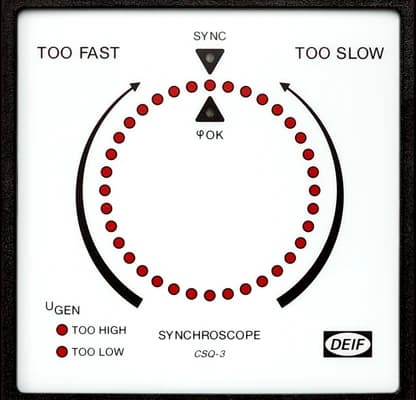
Isochronous mode holds exact speed regardless of load — for single-set or grid-connected operation. Droop mode allows proportional speed fall with load increase — essential for stable paralleling of multiple generators.
Reliability Ranking in Modern Service
Reliability is not absolute — it depends heavily on maintenance, operating environment, and installation quality. That said, field experience across industrial and marine applications gives us a consistent picture:
Indicative field reliability scores under routine maintenance conditions. Poor maintenance can invert this ranking entirely — a neglected hydraulic governor will always fail before a well-maintained EGOV.
How Modern Generator Speed Control Fits Together
If you’re managing a modern genset — say, a Perkins-powered package with a ComAp InteliGen 5 controller and an IG-AVRi voltage regulator — it helps to think about speed control as three distinct layers talking to each other.
Layer 1 — the Generator Management Controller is the brain. The ComAp InteliGen 5 knows the load on the bus, the generator frequency, the number of sets in parallel, and the demanded operating mode. It calculates what speed it wants and sends that command — as either an analogue signal or a digital CAN message — to the engine.
Layer 2 — the Engine ECU receives that speed demand and makes it happen by controlling fuel injection quantity and timing, and watching hundreds of engine parameters in real time. It talks back to the controller, reporting actual speed, torque output, active faults, and protection status over the CAN bus using the SAE J1939 protocol.
Layer 3 — the physical engine is where intentions become reality. The actuator moves the fuel rack. The turbocharger provides air. The crankshaft actually turns. Any physical constraint — blocked injector, worn turbo, stuck rack — breaks the chain here, and no amount of software can compensate.
The Speed Regulation warning can originate in any layer. A fault in Layer 3 (worn rings, low compression) will exhaust Layer 2’s ability to respond, which will exhaust Layer 1’s governor output — and the alarm will point at Layer 1 even though the real problem is at Layer 3. This is why methodical layer-by-layer diagnosis matters.
Common Faults in Modern ECU-Based Speed Control
Modern ECU-governed engines have exchanged some simple mechanical failure modes for more complex electronic and software-related ones. Here are the most frequently encountered faults grouped by subsystem:
| Fault Area | Specific Cause | Typical Symptom | Severity |
|---|---|---|---|
| Speed Sensor | Magnetic pickup loose, damaged, or with incorrect air gap | Erratic speed reading, intermittent hunting | High |
| CAN Communication | Termination resistor missing, corroded CAN connector, broken shield | DTC faults in controller, speed demand not received by ECU | High |
| PID Tuning | Governor gain too high after component swap or firmware update | Sustained hunting (hunting frequency 1–3 Hz) | Medium |
| Fuel System | Air in fuel lines, clogged secondary filter, weak lift pump | Speed drop under load, slow recovery | High |
| Actuator / Linkage | Corroded servo motor connector, binding throttle linkage | Command issued but rack doesn't move; actuator saturation | High |
| ECU Protection | Low oil pressure or overtemp triggering fuel derate | Speed limited to 75–80% of rated; alarm cascade | High |
| DC Supply | Battery voltage below 22V during cranking or running | ECU resets, controller loses communication, actuator weakens | Medium |
| Droop / Mode | Isochronous mode on a parallel set, or mismatched droop % | Load oscillation between sets, reverse power trip | Medium |
| Turbocharger | Worn or oil-starved turbo, blocked intercooler | Speed drop under load, black smoke, reduced max power | Medium |
| Software / Firmware | Corrupted ECU calibration file or governor parameter reset to defaults | Sudden onset of hunting after maintenance or power loss | Medium |
| Engine Wear | Low compression, worn injectors, valve timing drift | Unable to maintain speed at rated load; governor at maximum | Gradual |
Basic Troubleshooting: Eight Steps Any Engineer Can Do First
Before reaching for a CAN analyser or laptop diagnostic tool, work through these checks. The majority of speed regulation faults are found here — in things you can see, measure with a multimeter, or clear with a bleed screw.
- Read every active alarm and recent fault log
On the ComAp InteliGen, navigate to the alarm list and history. Note the sequence: what alarmed first. An oil pressure warning before the speed alarm often means the engine was already in derate mode. Screenshot or photograph the fault log before clearing anything.
- Check battery and DC supply voltage
Measure at the battery terminals and at the controller supply terminals with the engine running. You're looking for 24V ±1V (24V system) or 12V ±0.5V. Below 22V DC during operation can cause ECU resets and actuator weakness without triggering a dedicated electrical fault alarm.
- Inspect the speed sensor and its wiring
The magnetic pickup (MPU) air gap should be between 0.5–1.5mm on most Perkins engines — check the OEM spec. Inspect for physical damage, corrosion at the connector, and secure mounting. Loose wiring here causes intermittent speed signal noise that looks exactly like a tuning problem.
- Walk the throttle linkage and check the actuator
With the engine off, manually move the fuel control linkage through its full range. It should move freely and return against its spring. Any stiffness, binding, or missing return spring tension explains why the governor command isn't becoming fuel delivery.
- Service the fuel system
Replace primary and secondary fuel filters. Bleed any air from the fuel lines (Perkins engines have a specific bleed sequence — follow the engine manual). Check fuel lift pump pressure with a gauge if available. Air entrainment or low fuel pressure is the single most common cause of speed drop under load.
- Check the air intake system
Inspect the air filter restriction indicator if fitted. A blocked air filter on a turbocharged Perkins limits boost and sharply reduces available torque — the engine simply cannot make the power needed to maintain speed under load, regardless of how much fuel you throw at it.
- Verify governor mode and droop settings
For a single genset running alone: isochronous mode is correct. For parallel operation: both sets must be in droop mode, with matching droop percentages. A common commissioning error is leaving one set in isochronous when it's running in parallel — this will cause the isochronous set to "fight" the other and create load oscillation.
- Perform a controlled load test
Apply load in steps of approximately 25% rated capacity. Watch the speed on the controller display as each step is applied. A well-tuned system should recover to within 1% of setpoint within 3–5 seconds. Slow recovery points to tuning or fuel system issues; immediate limit at max governor output points to an engine capability problem.
Advanced Troubleshooting: CAN Bus & ECU-Level Diagnosis
When the basic checks don’t find the fault, or when you need to verify that the communication chain between the ComAp InteliGen and the Perkins ECU is intact and performing correctly, you need to go deeper. This is where CAN bus analysis and direct ECU interrogation become essential.
What to Capture on the CAN Bus
Connect a J1939-capable CAN logger to the genset CAN bus with the engine running. The following signals should be simultaneously logged at a minimum 100ms sample rate during a load step event:
SPN 898 — Engine Demand Torque (%) — what InteliGen is requesting
SPN 512 — Driver's Demand Engine Percent Torque
SPN 513 — Actual Engine Percent TorqueFUEL & ACTUATOR: PGN 65270 — Fuel Delivery Pressure, Fuel Rail Pressure
PGN 61443 SPN 102 — Boost Pressure (turbo inlet pressure)
SPN 1437 — Engine Fuel Injection Control PressurePROTECTION DERATES: PGN 65262 SPN 110 — Coolant Temperature
PGN 65263 SPN 100 — Engine Oil Pressure
PGN 65271 SPN 168 — Battery Voltage (at ECU)FAULTS: PGN 65226 — DM1: Active Diagnostic Trouble Codes
PGN 65227 — DM2: Previously Active DTCsGENERATOR & LOAD (ComAp proprietary): ComAp PGN: — Generator kW, kVAr, Frequency, Voltage
ComAp PGN: — Speed Setpoint, Speed Regulator Output %, Mode (droop/isoch)
// ComAp PGNs are proprietary — use InteliGen CAN configuration export to map IDs
How to Read the Load Step Event
Plot these signals time-aligned on a common time axis covering at least 10 seconds before and after the load step. You’re looking for a specific diagnostic narrative in the data:
Torque demand rises sharply after load step. Actual torque follows within 200–400ms. RPM dips then recovers to setpoint within 3–5s. No protection flags active. Fuel rail pressure stable.
Torque demand rises. Actual torque does not follow or lags severely. RPM continues to fall. No DM1 faults. Inspect actuator mechanically — the ECU is trying; the physics aren’t responding.
DM1 shows active fault (oil pressure, temp, or boost). Actual torque is capped below demand. RPM can’t recover because the ECU is legally limiting fuel. Fix the underlying protection fault first.
Speed demand PGN disappears from bus. ECU falls back to its internal default (usually idle or last known setpoint). Engine loses load. Check CAN termination (should read 60Ω across CAN H/L with ignition on, engine off).
PID Governor Tuning on ComAp InteliGen 5
If analysis confirms hunting rather than a hard fault, the issue is governor gain. On the InteliGen 5, the speed controller parameters are found under the Controller settings → Speed governor menu.
Proportional Gain (P): 20–35% · Integral Time (I): 0.3–0.6s · Derivative (D): 0.0–0.05s. Always tune with the set at rated load and normal operating temperature. Reduce P in 5% steps if hunting is observed. Increase I time if steady-state speed error persists. Engage derivative only when hunting remains after P/I adjustment.
Specific Checks for the ComAp IG-AVRi Interface
The IG-AVRi regulates alternator excitation, but its interaction with the speed governor matters in one important scenario: reactive load (motor starting, transformer inrush). A sudden kVAr demand can pull engine speed down just as effectively as a resistive load step. On the InteliGen 5, monitor voltage and VAr simultaneously with your speed trace during load events. If the speed dip correlates with a voltage dip rather than a kW step, AVR tuning — not speed governor tuning — is the primary adjustment needed.
Ashmit Engineering provides specialist diagnosis and controls engineering for diesel generator systems and marine engines — from ComAp InteliGen configuration through to Perkins, Volvo Penta, Scania, Cummins, and Caterpillar ECU parameter optimisation and multi-set paralleling commissioning. If you’ve worked through this guide and the alarm keeps returning, contact our team for site-specific support.
Real-world example: Emergency Generator PLC Control System
On the Atlantica Duke (ex-Highland Duke), our engineers diagnosed a locked Allen-Bradley MicroLogix PLC, built a new Siemens S7-1200 emergency generator control panel, and corrected a safety relay interlock logic fault — across three visits spanning two years.
Read the Aberdeen case study →