A Building Management System (BMS) reduces commercial building energy consumption by 15–30% by automating HVAC, lighting, and building services. This guide covers BMS control panels, IP ratings, system integration, energy dashboards, and how to calculate ROI — for facility managers and building owners across the UK.
If you manage or own a commercial building, you have almost certainly heard the term Building Management System — or BMS. But what does it actually do, and is it worth investing in? The short answer is yes. Often by a wider margin than most facility managers expect.
This guide covers everything: from physical control panels and their protection ratings, to how a BMS integrates every building service and gives your energy manager a real-time view of every kilowatt your building consumes.
What exactly is a BMS?
A Building Management System is a centralised software and hardware platform that brings your building's essential services under one roof. Think of it as the brain of your facility — monitoring, controlling, and automating everything from heating and ventilation to fire alarms, access control, and energy consumption, all from a single interface.
You may also hear it called a Building Automation System (BAS), an Intelligent Building Management System, or a Facilities Management System. The concept is the same: one integrated platform to oversee your building's operations. No separate tools, no separate teams.
At its core, a BMS is made up of sensors and field devices placed throughout your building. They measure temperature, humidity, CO₂, occupancy, smoke, and more. These feed into local controllers which make real-time adjustments. Everything reports back to a central platform your facilities team can monitor from a single screen. Cloud-connected platforms add multi-site dashboards, remote access, and centralised data storage.
BMS control panels — the physical heart of the system
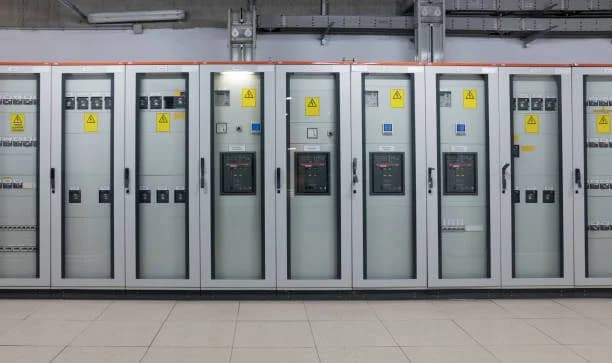
While the software dashboard is what most users interact with day to day, the physical BMS control panel is where the real intelligence lives. A BMS panel is a purpose-built enclosure housing the controllers, PLCs, power supplies, network switches, I/O modules, and wiring that connects every sensor and actuator in your building. Getting the panel design right is critical — it determines how reliably the system operates, how safely it can be maintained, and how easily it can be expanded in future.
Modern BMS control panels typically incorporate Programmable Logic Controllers (PLCs) or dedicated BMS controllers from manufacturers such as Schneider Electric, Siemens, or Honeywell. These devices run the control logic — the programmed sequences that decide when to activate a chiller, open a damper, or raise a fire alarm. Unlike older relay-based panels, PLC-driven BMS panels can be reprogrammed to adapt to changing building requirements without rewiring, which dramatically reduces the cost of future upgrades.
We design, build, and install BMS control panels from first principles — specifying the right controller platform for your application, engineering the panel layout for safe maintenance access, and writing the control logic to match your exact operational requirements. Every panel we produce is tested and commissioned before handover, and we provide full as-built documentation. See our industrial control system panels for more on our panel engineering capability.
IP protection ratings — what they mean and why they matter
Every BMS panel enclosure carries an IP (Ingress Protection) rating, which tells you how well it resists the entry of solid particles and water. Choosing the right IP rating for the installation environment is not a minor detail — an incorrectly rated panel in a plant room or rooftop location can fail within years from moisture or dust ingress, taking critical building services with it.
| IP Rating | Dust protection | Water protection | Typical BMS location |
|---|---|---|---|
| IP20 | Protected from fingers | None | Clean indoor electrical rooms |
| IP44 | Protected from solid objects >1mm | Splashing water | Plant rooms, service corridors |
| IP54 | Dust protected | Water jets from any direction | Rooftop plant, car parks, wash-down areas |
| IP65 | Fully dust tight | Water jets (low pressure) | Exposed outdoor locations, marine applications |
| IP66 | Fully dust tight | Powerful water jets | Coastal, heavy industrial, process environments |
| IP67/68 | Fully dust tight | Temporary / continuous immersion | Underground ducts, flood-risk areas |
Specifying an IP44 panel in a rooftop plant room or coastal location is a common and costly mistake. We assess every installation environment before specifying enclosures — ensuring your panel survives its location for its full operational life.
How a BMS panel integrates every building service
The real power of a BMS panel comes not from controlling one system in isolation, but from connecting all building services so they respond to each other intelligently. A BMS integration project joins systems that were historically designed and installed by separate trades — and makes them communicate as one.
Using industry-standard protocols — BACnet, Modbus, KNX, MQTT, and LonWorks — a BMS controller connects to equipment from different manufacturers and translates their data into a single, unified view. The diagram below shows how a BMS panel sits at the centre of a fully integrated building:
When integrated correctly, these systems stop being independent silos and start working together. When a fire alarm activates, the BMS simultaneously closes HVAC fire dampers to prevent smoke spreading, recalls lifts to the ground floor, unlocks designated escape doors, and notifies the security surveillance system — all within seconds, automatically. No manual coordination required.
Lift integration
Lift integration is one of the most valuable — and underused — capabilities of a modern BMS. By connecting via Modbus or BACnet, the BMS monitors lift status, energy use, fault codes, and call patterns in real time.
In fire mode, lift recall happens automatically. For energy management, lifts park in standby during off-peak hours — cutting motor energy use significantly. Usage data collected over months informs maintenance scheduling and capital planning.
Fire, access, and surveillance
Fire safety integration goes beyond alarm monitoring. A properly integrated BMS receives every zone status from the fire panel. It maps alarm events to specific areas, then coordinates the mechanical response — dampers, pressurisation fans, door releases — without waiting for human intervention. This is faster than manual response, and it is increasingly a regulatory expectation in commercial and high-rise buildings.
Access control integration lets the BMS respond to live occupancy data. If badge-in data shows a zone is empty, the BMS reduces ventilation and lighting in that area — recovering energy with no occupant discomfort. Surveillance cameras can also be triggered by BMS alarm events. A fire zone alarm, for example, automatically brings up the camera view for that zone on the operator's screen.
BMS panel installation — location, environment, and best practice
Where you install a BMS panel matters as much as what goes inside it. The ideal location balances four things: maintenance access, proximity to the systems being controlled, protection from environmental hazards, and network connectivity. Plant rooms are the most common choice for main panels — they offer direct access to mechanical equipment and are away from public areas. Sub-panels for individual floors or zones go in dedicated electrical cupboards or riser spaces.
Cable management is a discipline in its own right. Power cables and signal cables must be kept separate to avoid interference with sensitive control signals. All field wiring should be clearly labelled and documented. Full termination schedules are provided as part of the handover pack.
Our installation teams follow a structured commissioning process. Every I/O point is tested against the control schedule before the system goes live. Set-points are confirmed with the client's facilities team during a formal site acceptance test.
A BMS panel that is difficult to access, poorly documented, or installed without separation of power and signal cables creates a maintenance liability for the lifetime of the building. We engineer for maintainability from the outset — not as an afterthought.
How a BMS drives energy efficiency
Energy efficiency is consistently the top commercial driver for BMS investment — and for good reason. A well-configured BMS typically reduces a building's energy consumption by 15–30%, with some projects delivering savings beyond that when the system is actively managed rather than simply installed and forgotten.
The mechanisms are varied. Optimal start-stop scheduling ensures HVAC systems run only when the building needs them, using weather data and occupancy forecasts to calculate the latest possible start time that still achieves comfort conditions by occupation. Demand-controlled ventilation uses CO₂ sensors to modulate fresh air delivery to exactly what occupants require. Free cooling strategies use economiser modes to deliver cooling using outdoor air when conditions allow, avoiding mechanical refrigeration entirely for significant portions of the year.
The BMS energy dashboard — what your energy manager sees
An energy manager without data is flying blind. A BMS dashboard changes that completely, delivering a real-time view of every energy stream in the building — electricity, gas, water, and thermal — broken down by system, floor, zone, or time period. Below is an example of what a typical BMS energy dashboard looks like in practice:
This kind of granular, real-time visibility lets energy managers identify waste that would otherwise be invisible — a zone running overnight when it should be setback, a chiller consuming more power than expected for a given outdoor temperature, or a lighting circuit failing to switch off in an unoccupied area. Over time, the historical data builds a baseline against which every change can be measured and justified.
Long-term, the BMS dashboard also supports mandatory energy reporting obligations. ESOS, SECR, and MEES compliance all rely on accurate, auditable energy data — data that a BMS generates automatically, reducing the administrative burden on facilities and sustainability teams considerably.
From traditional to smart — how a BMS transforms a building
The phrase "smart building" is used frequently, but what it actually means in practice is a building where systems respond intelligently to real-world conditions rather than running on fixed schedules regardless of what is actually happening inside. A BMS is the technology that makes that transformation possible — and it can be applied to existing buildings, not just new developments.
Consider a typical 1990s office block: individual thermostats in each room, a fire panel that sounds an alarm but does nothing else automatically, lighting on manual switches, and no connection between any of these systems. A BMS retrofit and upgrade project replaces the isolated controls with a unified network, adds sensors to gather occupancy and environmental data, installs a central controller that runs optimised strategies across all systems, and provides a dashboard through which the building manager can see and adjust everything from a single screen.
We have delivered BMS retrofit projects in buildings ranging from single-floor commercial offices to multi-site hospital estates. Each project begins with a detailed site survey and energy baseline study — so we know exactly what the system needs to achieve and can demonstrate results against it. Our support and consultancy team can carry out an independent survey of your current BMS performance with no obligation.
Custom BMS panel design — built for your specific needs
No two buildings are identical, and no two BMS panels should be either. Off-the-shelf controllers have their place in standard applications, but complex buildings — with unusual mechanical configurations, legacy equipment that needs integration, specialist processes, or demanding environmental conditions — require panels that are engineered specifically for the application.
Our custom panel design service covers the full range of BMS applications: standard commercial building controls, industrial process monitoring and control, marine and offshore environments, healthcare facilities with stringent regulatory requirements, and data centres where uptime is paramount. We work with a wide range of controller platforms — Siemens DESIGO, Schneider EcoStruxure, Trend, Distech, Delta Controls, and others — selecting the most appropriate platform for your application rather than defaulting to a single preferred brand.
Long-term benefits — what a BMS delivers over its lifetime
A BMS is not a one-time purchase — it is a long-term asset that pays dividends for the life of the building when properly maintained and actively used. Beyond the immediate energy savings, the long-term benefits compound significantly over five to fifteen years of operation.
Predictive maintenance is one of the most commercially valuable long-term capabilities. By monitoring equipment performance data continuously, the BMS builds a profile of normal operating behaviour for every major plant item. When a chiller begins drawing slightly more power than expected for a given load, or a pump's vibration signature changes subtly, the system flags these as early warning indicators — allowing a maintenance visit to be scheduled before a failure occurs. That shift from reactive to proactive maintenance reduces emergency repair costs, extends equipment life, and avoids the disruption of unplanned breakdowns. Our 24/7 breakdown assistance is available when you need rapid response.
Regulatory compliance becomes simpler too. As energy reporting obligations, carbon reduction commitments, and building performance standards continue to tighten, the audit trail of data held by a BMS becomes genuinely valuable — both for demonstrating compliance and for identifying the interventions most likely to improve performance cost-effectively.
Finally, BMS data supports better capital planning. When the system has been tracking equipment runtime, fault frequency, and performance degradation over several years, the decision about when to replace a major plant item is no longer based on opinion — it is based on evidence. That changes the quality of capital expenditure decisions and prevents under-investing in equipment that is approaching the end of its reliable service life.