What is a DP2 vessel?
A DP2 vessel (also written as DP 2 or DP Class 2) is a marine vessel certified to Equipment Class 2 under the IMO Guidelines for Vessels with Dynamic Positioning Systems (MSC/Circ.645). The defining characteristic is single-failure redundancy: the vessel's dynamic positioning system must be able to maintain position and heading following any single active failure in the system — from a thruster failure to a PLC fault to a power management trip.
Unlike DP1 vessels, which carry no redundancy requirement, DP2 achieves this reliability by duplicating critical systems and housing those duplicate systems in physically separated compartments. A fire or flood in one machinery space cannot simultaneously disable the backup system.
DP2 is the standard classification for the offshore support vessel (OSV) sector and for most vessels engaged in subsea, pipe-laying, cable-laying, platform supply, and well intervention operations.
DP2 requirements and redundancy rules
The DP2 standard is defined by a combination of IMO MSC/Circ.645 and the individual class society rules of DNV, Lloyd's Register, Bureau Veritas, ABS, ClassNK and others. The core DP2 requirements are:
| System | DP2 requirement |
|---|---|
| DP controller | Minimum two independent DP computers with automatic changeover |
| Thrusters | Sufficient redundant thrusters that loss of any single thruster does not cause loss of position |
| Power generation | Duplicated generator sets; failure of one power bus must not cause loss of all propulsion |
| Position reference sensors | Minimum three independent reference systems (e.g. DGPS, HPR, taut wire) |
| Environmental sensors | Redundant wind sensors, motion reference units (MRU), gyrocompasses |
| Physical separation | Redundant systems located in separate compartments separated by A-class fire divisions |
| UPS / uninterruptible power | Battery-backed UPS for DP control systems to survive momentary power interruption |
The critical distinction is the worst-case failure mode (WCFM). A DP2 vessel must be designed so that no single active failure — a short circuit, a software fault, a thruster trip — causes loss of position. Passive failures (such as the hull flooding) are not covered by DP2; that scenario requires DP3.
DP2 vs DP1: the key differences
The fundamental difference between DP1 and DP2 is redundancy. A DP1 vessel has no mandatory redundancy requirement — a single component failure can result in loss of position (LPOD). DP2 requires that the system design ensures no single failure causes LPOD.
| Feature | DP1 | DP2 |
|---|---|---|
| Single failure protection | Not required | Required for all active failures |
| DP computers | Single controller acceptable | Minimum 2 independent controllers |
| Physical separation of redundant systems | Not required | Mandatory — separate compartments |
| Typical charter premium over DP0 | Moderate | Significant |
| Subsea / pipeline operations | Restricted or prohibited | Standard requirement |
| Typical vessel types | Anchor handlers, small OSVs, survey vessels in benign conditions | Platform supply vessels, cable layers, dive support vessels, IMR vessels |
DP2 vs DP3: when is DP3 required?
Both DP2 and DP3 require redundancy — the difference is the severity of failure each classification must survive. DP2 protects against any single active failure. DP3 requires the vessel to maintain position even if an entire watertight or fire-resistant compartment is lost — for example, from fire or flooding.
| Feature | DP2 | DP3 |
|---|---|---|
| Failure case covered | Any single active failure | Loss of any one watertight/fire division |
| Physical separation standard | A-class fire division between redundant systems | Watertight AND fire divisions — full compartmentalisation |
| DP computers | 2 independent systems | 3 independent systems (often on separate bus) |
| Typical application | Subsea IMR, pipe-laying, cable-lay, well services | Wellhead operations, deepwater drilling, saturation diving support |
| Regulatory driver | Operator/oil company DP requirements | IMO MODU Code; flag state regulations for well operations |
DP3 vessels are significantly more expensive to build and operate — the full compartmentalisation requirement adds hull complexity and weight. For the majority of offshore support and subsea construction work, DP2 is the practical ceiling of what operators require and what the market demands.
For a complete breakdown of all three classes, see our guide: DP1, DP2 and DP3 Vessel Classification Explained →
What operations require a DP2 vessel?
DP2 is the de facto minimum for most commercial offshore work where an accidental loss of position would pose a risk to the environment, subsea infrastructure, or personnel. Typical DP2 operations include:
- Subsea installation, inspection, maintenance and repair (IMR) operations
- Pipeline and riser lay operations near subsea equipment
- Cable-laying within proximity of existing infrastructure
- Offshore platform supply above or near critical subsea assets
- Offshore wind turbine installation and maintenance (CTV and WTIV operations)
- Well stimulation, intervention and coiled tubing operations
- Diving support vessel (DSV) operations with divers in the water
- Crane vessel operations near offshore structures
- Rock dumping and subsea trenching
Individual field operators (major oil companies, wind developers, and tier-one contractors) typically specify minimum DP class in their marine warranty and vessel approval requirements. In practice, DP2 approval from a recognised class society is mandatory for most tendered offshore work globally.
DP2 control system and propulsion equipment
A DP2 vessel's control system integrates multiple independent subsystems, all working together to maintain position. The main components are:
DP controller (DP computer)
The DP computer takes inputs from all position reference and environmental sensors and calculates the required thruster demand to maintain set position and heading. DP2 vessels carry a minimum of two independent DP computers — typically from manufacturers such as Kongsberg Maritime, L-3 Nautronix, Marine Technologies, or IXBlue — with automatic switchover in the event of a primary system failure. The computers must be located in physically separated spaces.
Position reference systems
DP2 requires a minimum of three independent position reference systems operating simultaneously. Common configurations include:
- DGNSS / DGPS — differential global navigation satellite system (minimum two receivers from separate satellite constellations)
- HPR / USBL — hydroacoustic position reference using transponders on the seabed
- Taut wire — mechanical wire tensioned to a clump weight on the seabed
- Fanbeam / Cyscan — laser-based reference to a fixed target on an installation
- Artemis — microwave reference system for short-range positioning near a fixed structure
Thruster and propulsion systems
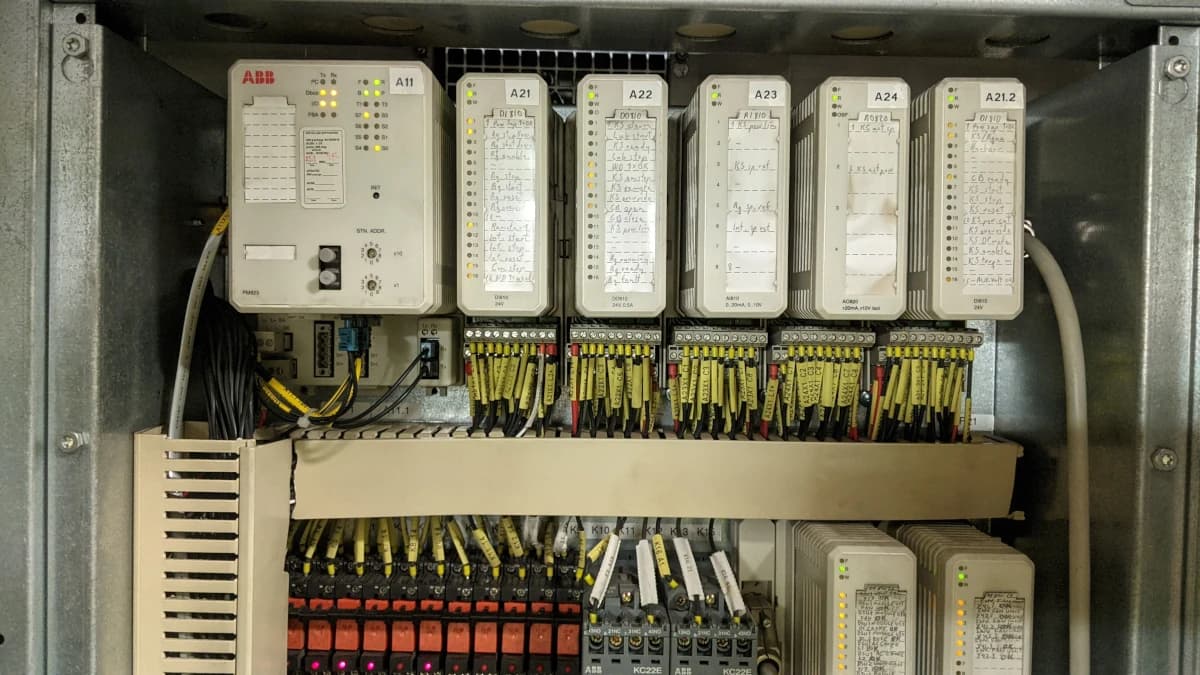
DP2 vessels typically combine azimuth thrusters with tunnel thrusters to achieve omnidirectional force. Azimuth thrusters — driven by variable frequency drives such as ABB ACS800 or Siemens SINAMICS — are the primary positioning actuators. The drive system for azimuth thrusters is a common point of failure; Ashmit Engineering specialises in ACS600 and ACS800 azimuth drive repairs → and emergency fault recovery for DP2 vessels.
Power management system (PMS)
The power management system coordinates generator loading and bus-tie operations. DP2 requires split bus operation for redundancy: in the event of a fault on one bus bar section, the bus tie opens and isolates the fault, preserving power to the redundant thruster group. The DP computer communicates with the PMS to ensure sufficient power margin is always available for thruster demand.
See our related guide on marine propulsion control systems → for more detail on CPP and azimuth thruster integration with DP systems.
DP2 certification, FMEA and class notation
DP2 class notation is awarded by a recognised classification society following a multi-stage process. The main steps are:
- Design review — the class society reviews the vessel's DP system design, redundancy concept, and single-line diagrams to verify that the DP2 requirements can be met in principle.
- Failure Mode and Effects Analysis (FMEA) — a systematic document identifying every possible failure mode in the DP system and demonstrating that no single failure can cause loss of position. The FMEA is submitted to class for review and approval.
- FMEA proving trials — the failure modes identified in the FMEA are physically tested onboard the vessel at sea to demonstrate compliance. Class surveyors attend the trials.
- Annual surveys and 5-year periodical surveys — ongoing maintenance of the class notation requires annual DP-related checks and a comprehensive five-yearly survey including repeat FMEA proving trials.
Class notation for DP2 varies by society: DNV uses DYNPOS-AUTR or DP(AA), Lloyd's Register uses DP(AM), and ABS uses DPS-2. These notations are functionally equivalent to IMO Equipment Class 2.
Frequently asked questions
What does DP2 mean on a vessel?
DP2 means the vessel's dynamic positioning system is certified to IMO Equipment Class 2. The system must maintain position and heading following any single active failure — achieved through duplicated thrusters, DP computers, generators and position reference systems in physically separated compartments.
What are the DP2 vessel requirements?
DP2 requires: (1) minimum two independent DP computers with auto-changeover; (2) sufficient redundant thrusters that no single thruster failure causes loss of position; (3) duplicated power generation with split bus protection; (4) minimum three independent position reference systems; (5) all redundant systems physically separated by A-class fire divisions. The design is validated by a class-approved FMEA and proving trials.
What is the difference between DP1 and DP2?
DP1 has no redundancy requirement — a single failure can cause loss of position. DP2 requires single-failure redundancy: no single active fault may result in loss of position. DP2 vessels must physically separate redundant systems in different compartments, carry multiple DP computers, and operate on a split-bus power system.
What is the difference between DP2 and DP3?
Both DP2 and DP3 require single-failure redundancy. The difference is that DP3 must also maintain position after loss of an entire compartment due to fire or flooding — requiring watertight and fire separations between all redundant systems, plus a third independent DP computer. DP3 is required for wellhead operations and deepwater drilling; DP2 is sufficient for most subsea construction and IMR work.
What is a DP2 vessel used for?
DP2 vessels are the standard platform for offshore subsea operations: IMR (inspection, maintenance and repair), pipe-laying, cable-laying, dive support, well intervention, offshore wind installation, crane operations near structures, and platform supply to installations with subsea infrastructure below.
How long does it take to get DP2 class notation?
The timeline depends on the vessel's starting point. For a newbuild, DP2 design review, FMEA and trials are integrated into the construction programme — typically 18–36 months. For a vessel being upgraded from DP1 to DP2, a full system redesign, FMEA and proving trials are required, which typically takes 6–18 months depending on the scope of modifications.
What happens if a DP2 vessel loses position?
A DP2 incident (loss of position, heading, or drive) triggers immediate escalation procedures. If position is lost while working near subsea infrastructure, ROVs are typically recovered, the diving bell returns to surface, and subsea intervention equipment is secured or retrieved. DP incidents are reported to the vessel's flag state and — in the North Sea — to the International Marine Contractors Association (IMCA) through the DP incident reporting programme.