Marine propulsion control systems govern how a vessel's bridge commands translate into thruster and CPP response. This guide covers controllable pitch propeller (CPP) systems, hydraulic HPU design, OEM controllers (Berg, KaMeWa, Rolls-Royce, Wärtsilä), common failure modes, and when to consider a controls system upgrade.
What Is a Marine Propulsion Control System?
A marine propulsion control system is the integrated network of hardware, software, and signal pathways that translates an officer's speed order at the bridge into physical thrust at the propeller.
It is not a single device. It is a system of systems, spanning multiple physical locations aboard the vessel and involving multiple interacting technologies.
At its core, propulsion controls engineering manages two fundamental variables: engine RPM and, where fitted, propeller pitch. The relationship between these two variables — and how they are coordinated in response to operator commands — defines the performance, efficiency, and safety of the vessel's propulsion.
The command chain runs from the bridge, through the Engine Control Room (ECR), to the main engine and its associated hydraulic pitch control system. Each step involves signal conversion, safety checking, and feedback — making the entire system a closed-loop control architecture.
Why Propulsion Controls Engineering Matters
The practical importance of well-functioning marine propulsion controls is easy to understate. These systems must handle:
- Rapid demand changes — from a loaded harbour manoeuvre where the telegraph moves from slow ahead to full astern in seconds, to steady deep-sea cruising at optimum efficiency
- Safety interlocks — preventing engine overload, overspeed, and cavitation even if the operator commands an unsafe condition
- Redundancy requirements — most vessels carry backup control modes: bridge control, ECR control, and local (engine-side) control, with defined priority rules
- System integration — a modern vessel's propulsion automation interfaces with the power management system, dynamic positioning (DP) system, alarm management, and voyage data recorder
Failures in propulsion controls have been implicated in groundings, collisions, and machinery damage. MAIB and IMO reports consistently highlight one pattern: degraded control system performance on ageing vessels. It is a contributing factor in many propulsion-related incidents.
The Architecture: How the System of Systems Works
Understanding these systems starts with the signal flow. At every stage, a command is received, validated, processed, and converted into a physical output.
Here is how that flow works on a typical vessel with a diesel main engine and a controllable-pitch propeller (CPP).
1. Bridge — Where the Command Originates
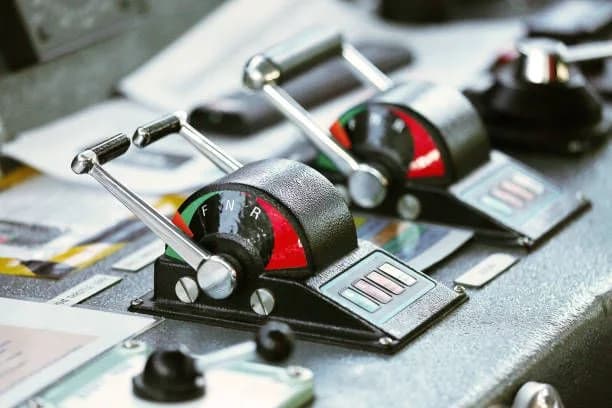
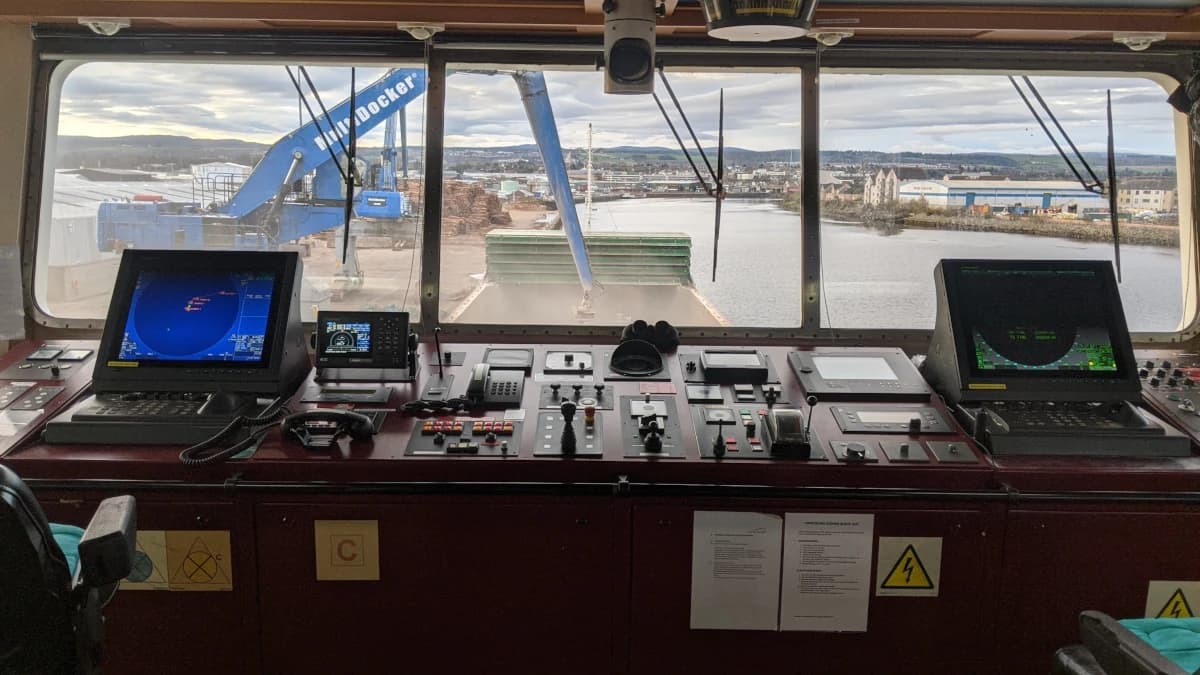
The officer of the watch (OOW) issues a speed order using the bridge telegraph or a combined control lever. On modern vessels this is an electronic joystick or lever. On older vessels it may be a traditional electro-mechanical telegraph.
The bridge control station sends a speed demand signal — a requested thrust level — to the ECR automation system. Each telegraph position corresponds to a pre-calibrated demand percentage in the control system logic:
| Telegraph Position | Direction |
|---|---|
| Full Ahead | Ahead |
| Half Ahead | Ahead |
| Slow Ahead | Ahead |
| Dead Slow Ahead | Ahead |
| Stop | — |
| Dead Slow Astern | Astern |
| Slow Astern | Astern |
| Half Astern | Astern |
| Full Astern | Astern |
The bridge signal is not a direct actuator command. It is an intent. The propulsion control system's job is to translate that intent into safe, achievable physical outputs.
2. Engine Control Room — The System Brain
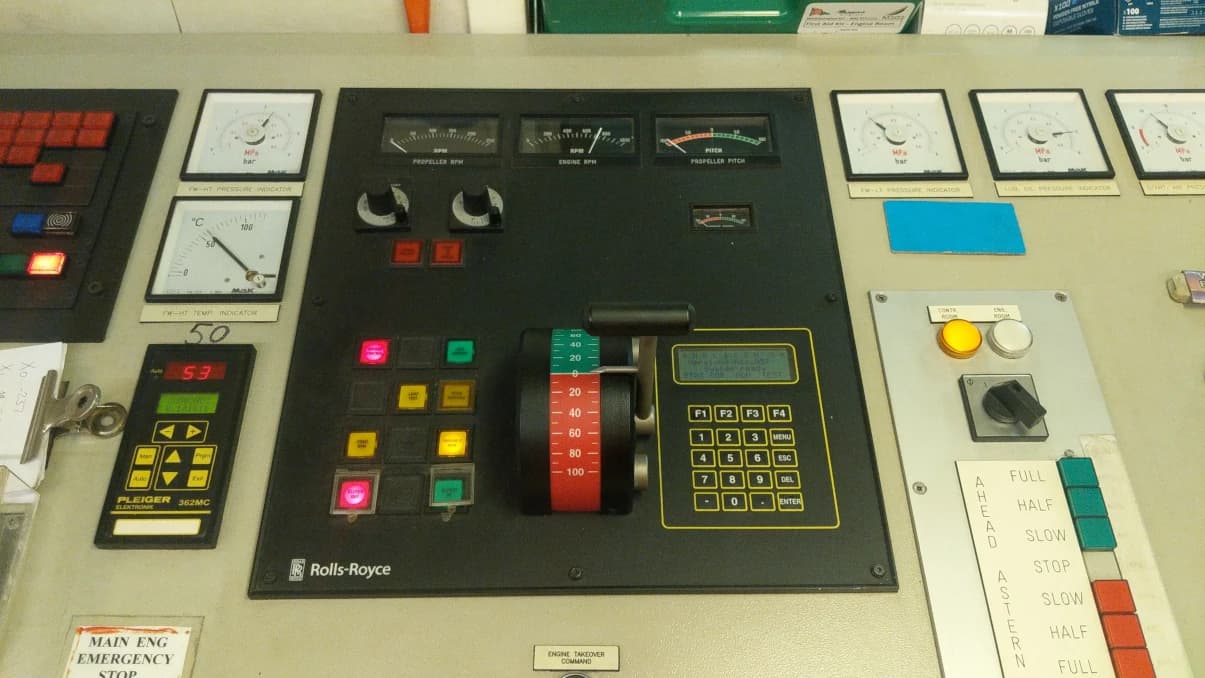
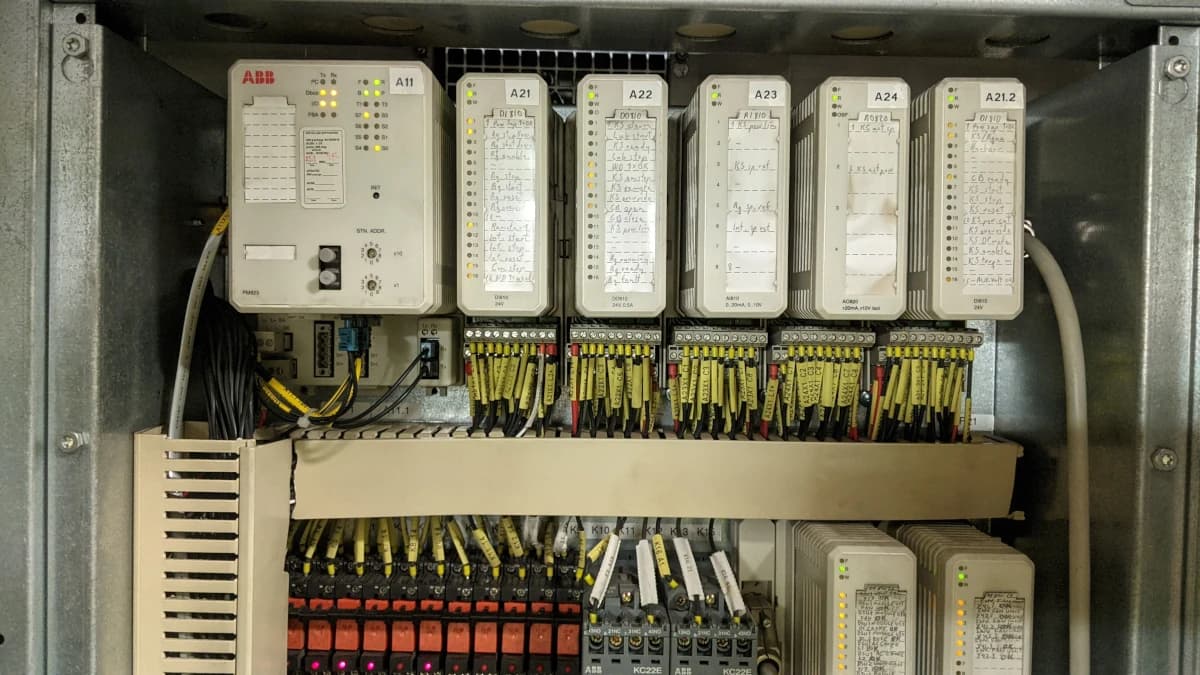
The Engine Control Room (ECR) contains the propulsion control PLC (programmable logic controller) or automation panel that acts as the system brain. This is where:
- The bridge demand signal is received and validated
- Safety interlocks are applied
- Setpoints are calculated and issued to the main engine governor and pitch controller
- Control mode priority is managed (bridge, ECR, or local)
- Alarm conditions are monitored and logged
The ECR also houses telegraph repeaters — displays that confirm to the engine room watch what order has been received from the bridge.
In propulsion controls engineering, the ECR automation is typically the product of the vessel's original OEM system integrator. Common providers include Kongsberg, Wärtsilä, Berg Propulsion (now part of Caterpillar Marine), and Rolls-Royce (now Kongsberg following the 2019 maritime acquisition).
3. Main Engine — RPM Control
The main engine receives an RPM setpoint or torque demand from the ECR automation. The engine's governor manages fuel injection to reach and hold the commanded speed.
On vessels with a controllable-pitch propeller, the main engine typically runs at or near a fixed RPM. The governor holds the engine speed stable while the pitch controller varies the propeller blade angle to modulate thrust. This is known as fixed-RPM mode — the most common configuration for CPP-equipped vessels.
On vessels with a fixed-pitch propeller, the engine governor directly controls thrust by varying RPM. There is no pitch controller — the control architecture is simpler, but flexibility is reduced.
4. The Controllable-Pitch Propeller System
The controllable-pitch propeller (CPP) is the defining feature of sophisticated marine propulsion controls engineering. Rather than changing engine speed to change thrust direction, a CPP vessel varies the angle of the propeller blades while the shaft continues to rotate in the same direction.
This architecture offers significant operational advantages:
- Rapid thrust reversal without reversing engine rotation
- Precise, fine-grained thrust control for harbour manoeuvring and dynamic positioning
- Ability to hold constant engine RPM for optimal generator loading on diesel-electric vessels
- Better fuel efficiency across a wide range of vessel speeds
The CPP system consists of three integrated subsystems: the pitch controller, the hydraulic power unit (HPU), and the pitch actuator mechanism in the propeller hub.
Key Components in Detail
Bridge Telegraph Controls
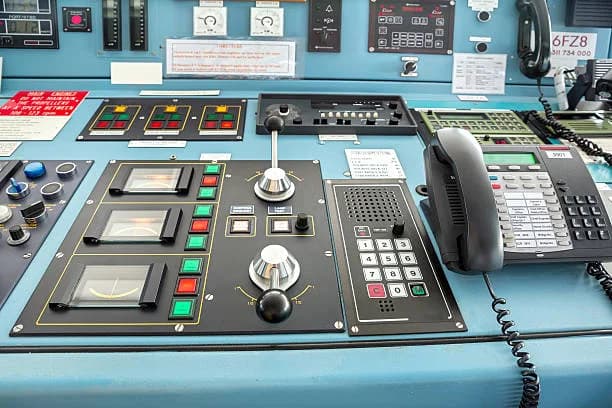
The bridge telegraph is the primary human-machine interface in a marine propulsion control system. On modern vessels, this is an integrated lever or joystick that may also control bow thrusters, stern thrusters, and azimuth drives from a single station.
Telegraph positions are mapped to specific demand percentages in the control system calibration. A typical mapping:
| Telegraph Position | Demand % | Typical Engine RPM | Typical Pitch |
|---|---|---|---|
| Full Ahead | 100% | 750 RPM | +30° |
| Half Ahead | 66% | 500 RPM | +20° |
| Slow Ahead | 33% | 250 RPM | +12° |
| Dead Slow Ahead | 15% | 100 RPM | +6° |
| Stop | 0% | 0 RPM | 0° |
| Dead Slow Astern | 15% | 100 RPM | −6° |
| Slow Astern | 33% | 250 RPM | −12° |
| Half Astern | 66% | 500 RPM | −20° |
| Full Astern | 100% | 750 RPM | −30° |
Actual values are vessel-specific and set during sea trials and OEM commissioning.
The Pitch Controller
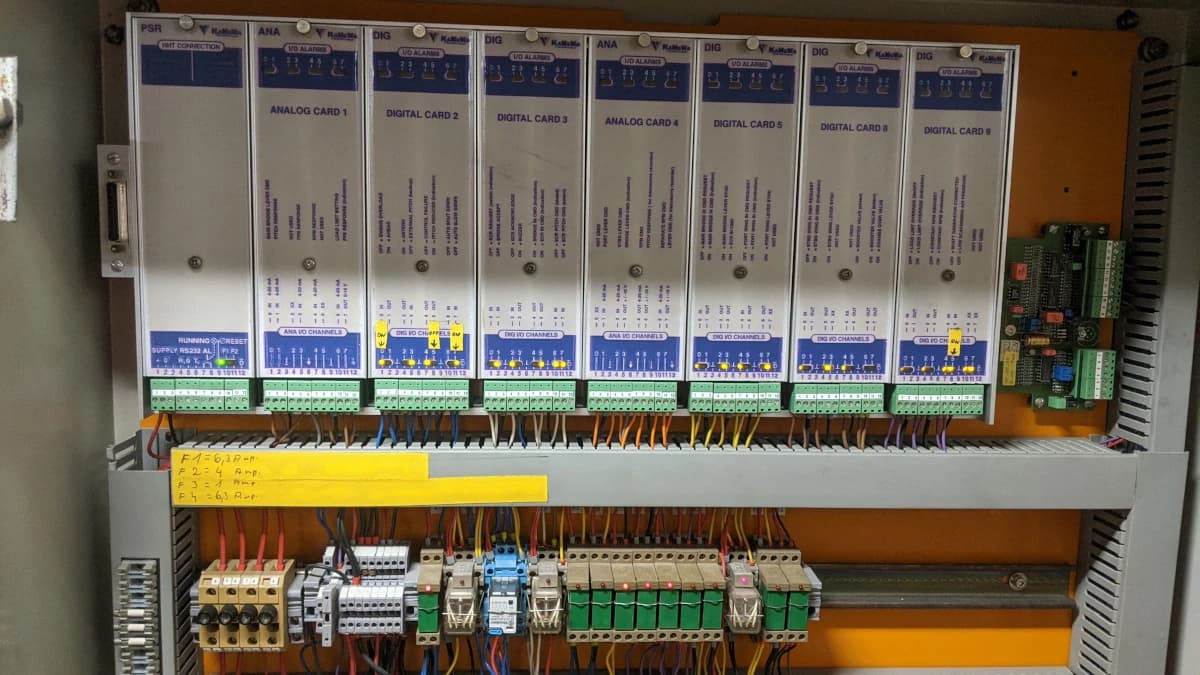
The pitch controller is the computational heart of CPP-based propulsion controls engineering. It receives a pitch demand signal from the ECR automation, reads the actual pitch position from a position transducer on the actuator, and commands the hydraulic servo valve to move the blades to the target angle.
It operates as a closed-loop servo control system: the difference between commanded pitch and actual pitch (the error signal) drives the hydraulic valve. As actual pitch approaches the setpoint, the valve closes down, preventing overshoot.
The pitch controller also enforces the combinatory curve — the engineered relationship between pitch angle and engine RPM that keeps the engine within safe torque limits across all operating conditions. This curve is calculated during initial design and programmed into the control system during commissioning.
Hydraulic Power Unit and Actuator
The HPU provides the pressurised hydraulic fluid that physically moves the propeller blades. It consists of hydraulic pumps, a reservoir, filters, pressure relief valves, accumulators, and associated pipework.
Pressurised fluid is routed to proportional or servo valves controlled by the pitch controller. These valves direct fluid to either side of the pitch actuator — a hydraulic cylinder or rotary piston inside the propeller hub — to rotate the blades to the commanded angle.
Position feedback from a transducer (resolver, LVDT, or encoder) on the actuator closes the loop, confirming to the pitch controller that the commanded pitch has been achieved.
The accumulator provides emergency pitch-change capability in the event of hydraulic power loss — a critical safety feature in any CPP control system.
Bow and Stern Thruster Controls
Most commercial vessels are equipped with one or more transverse thrusters — tunnel thrusters in the bow and/or stern — that provide lateral thrust for harbour manoeuvring without main engine involvement.
These are controlled from the bridge through a separate control panel, or increasingly through an integrated conning system that combines main propulsion, rudder, and thruster controls.
Thruster controls are an integral part of the marine propulsion control package on vessels equipped for dynamic positioning (DP), where all thrust devices must be coordinated automatically by the DP control system.
Control Modes and Priority Hierarchy
A defining feature of robust propulsion controls engineering is the control mode hierarchy. At any given time, the propulsion system must be under the command of exactly one control station.
The standard hierarchy is:
Transfer between control modes requires deliberate action — typically a physical key switch or confirmed button press at the station taking control. The handover is logged in the vessel's automation system.
During bridge control, the engineer in the ECR monitors the system but does not issue commands. Local control is reserved for emergencies where the automation system has failed.
OEM Systems: Berg, KaMeWa, Rolls-Royce, and Wärtsilä
The marine propulsion control systems market is dominated by a handful of major original equipment manufacturers (OEMs). Understanding their systems is important for any engineer or superintendent managing vessels equipped with them.
Berg Propulsion (Caterpillar Marine)
Berg Propulsion is a Swedish manufacturer with a long history in CPP systems and marine automation for commercial vessels. Their systems are widely found on offshore support vessels, tugs, ferries, and naval vessels.
Berg CPP systems are known for robust hydraulic design and a control philosophy that prioritises reliability and ease of maintenance. Following acquisition by Caterpillar, Berg systems are increasingly integrated with Caterpillar's wider marine automation offering.
KaMeWa (Kongsberg)
KaMeWa is one of the most recognised names in CPP and propulsion controls engineering globally. Originally a Swedish manufacturer, KaMeWa systems were acquired by Rolls-Royce and subsequently by Kongsberg Maritime.
KaMeWa CPP systems are found across a very wide range of vessel types — from passenger ferries to large merchant vessels to naval ships — and are regarded as a benchmark for precision pitch control engineering.
Rolls-Royce Marine (now Kongsberg)
Rolls-Royce Marine developed a comprehensive range of propulsion controls systems including CPP systems, azimuth thrusters, and integrated bridge-to-propeller automation packages.
Following Kongsberg's acquisition of the marine division in 2019, these systems are now supported and developed under the Kongsberg brand. Many vessels in service today carry Rolls-Royce-designed CPP control systems.
Wärtsilä
Wärtsilä produces a broad range of propulsion solutions including fixed-pitch and controllable-pitch propellers, azimuth thrusters, and associated control systems. Their integrated automation is widely used across merchant shipping and special purpose vessels.
Common Failure Modes and Ageing Challenges
One of the most practically important areas of CPP system maintenance is understanding how these systems degrade over time. Mechanical wear, hydraulic degradation, and control electronics ageing all occur simultaneously and interact with each other.
Hydraulic System Degradation
The hydraulic system is typically the first to show age-related symptoms.
Contaminated oil causes increased wear on servo and proportional valves, reducing their responsiveness and accuracy. Worn pumps lose the ability to maintain required system pressure, resulting in slow or incomplete pitch response. Ageing hoses and seals develop leaks, causing pressure loss and reduced ability to hold the commanded pitch angle under propeller thrust loading.
Air entrainment in the hydraulic fluid (foaming) is a particularly insidious problem — it causes unpredictable, spongy actuator response that is difficult to diagnose without hydraulic oil analysis.
Position Sensor Degradation
The pitch position transducer is the feedback element that closes the servo control loop.
As it degrades — through electrical noise, mechanical wear, or connection faults — the pitch controller begins to receive inaccurate position readings. This causes the controller to continuously correct toward a phantom error, driving the actuator against the actual pitch stop. The symptom is a pitch that hunts continuously around the setpoint, or a steady-state error that increases over time.
Control Electronics Ageing
Older CPP control systems — particularly those from the 1990s and early 2000s — were built on hardware that is now obsolete.
I/O cards fail, firmware updates are no longer available, and spare parts can be impossible to source. Signs of ageing control electronics include intermittent faults that are difficult to reproduce, increasing pitch controller response times, and alarms that trigger spuriously due to degraded signal conditioning.
Combinatory Curve Mismatch
Over time, vessel performance changes. Hull fouling, propeller erosion and blade tip damage, and engine wear all shift actual performance characteristics away from those used when the combinatory curve was originally programmed.
If the control system's pitch-to-RPM mapping no longer reflects the actual propulsion system, the engine may be regularly operated in an overloaded or under-utilised condition — reducing efficiency and increasing wear.
Inspection and Maintenance Priorities
A structured maintenance programme is not optional for marine propulsion control systems — it is the difference between catching a developing fault before a critical voyage and dealing with a propulsion failure at sea.
- HPU pressure readings under load — confirm against design specification
- Emergency accumulator charge level and functional test of emergency feathering
- Position transducer readings vs. manual pitch measurement — confirm feedback accuracy
- Overspeed and ESD interlock functional tests
- All CPP-related alarms — confirm active and properly configured
- Step-response test of the pitch actuator — record settling time, overshoot, and steady-state error as a baseline
- Hydraulic oil sample analysis for contamination, water content, and particle count
- Servo and proportional valve bench-test or in-situ functional check
- HPU filter inspection and pump wear assessment
- Position sensor calibration and zero-pitch stop verification
- Full actuator overhaul per manufacturer interval
- Propeller blade inspection and performance survey
- Combinatory curve revalidation after any hull or propeller repairs
- Control PLC firmware status review and redundancy logic verification
- Spare parts inventory audit: proportional valves, position transducers, seals, servo amplifiers
Free Download: CPP Inspection & Maintenance Checklist
A printable, fillable PDF covering all inspection and maintenance tasks for controllable pitch propeller systems — safety-critical, high-priority, and scheduled items. Use it onboard or in pre-drydock planning.
Download checklist (PDF)When to Consider a Controls System Upgrade
Propulsion controls engineering upgrades are a significant investment. But there are clear indicators that the cost of maintaining an ageing system has approached — or exceeded — the cost of replacement:
- Spare parts are no longer available from the OEM
- The system has experienced more than two unplanned propulsion control failures in 12 months
- Position feedback accuracy cannot be restored to within OEM tolerance
- The combinatory curve cannot be updated because the programming interface is no longer supported
- Insurance or classification society requirements trigger mandatory equipment upgrades
Modern retrofit CPP control systems offer significant advantages over legacy designs. Digital fieldbus communications eliminate ageing wiring, modern PLCs provide better diagnostics and remote monitoring, and updated HMI interfaces improve operator visibility.
Frequently Asked Questions
What is a controllable pitch propeller system?
A controllable pitch propeller (CPP) system allows the angle of the propeller blades to be changed while the shaft is rotating. This enables the vessel to change thrust direction and magnitude without reversing the engine, providing greater manoeuvring flexibility and — in fixed-RPM configurations — better efficiency across varying load conditions.
What does a pitch controller do?
The pitch controller is the automation unit that receives a pitch demand signal from the ECR or bridge and uses a closed-loop servo algorithm to move the propeller blades to the commanded angle via hydraulic actuators. It continuously monitors actual pitch via a position transducer and corrects any error between commanded and actual pitch.
What is the combinatory curve in propulsion controls engineering?
The combinatory curve is a pre-programmed relationship between propeller pitch angle and engine RPM stored in the propulsion control system. It ensures that when a speed demand is issued, the resulting pitch and RPM combination keeps the engine within its torque limit and the propeller operating without cavitation. The curve is calculated by the propeller designer and implemented during sea trials.
Why do marine propulsion control systems fail?
The most common causes are hydraulic system degradation (contamination, wear, leaks), position sensor faults, ageing control electronics, and calibration drift caused by changes in vessel performance over time. Failures are more frequent on vessels over 15 years old where original spare parts are difficult to source.
What is the difference between bridge control and ECR control?
Bridge control means propulsion demands are issued directly from the bridge — typically via a telegraph lever or joystick — and the ECR automation executes those demands automatically. ECR control means an engineer in the Engine Control Room is managing the propulsion system directly, often for close monitoring during complex manoeuvres or fault conditions. The vessel can only be under one control mode at a time, with a defined handover procedure between them.
Can an ageing propulsion control system be upgraded without replacing the main engine?
Yes. Modern propulsion controls engineering upgrades are designed to interface with existing main engines, gearboxes, and CPP hydraulic systems. The upgrade replaces the control electronics, HMI panels, and signal interfaces while retaining the mechanical propulsion components. This is significantly less expensive than a complete propulsion plant replacement and can dramatically improve reliability and diagnostic capability.
CPP Breakdown Support, Upgrades and Parts — Ashmit Engineering
When a CPP system fails at sea or in port, response time is everything. Ashmit Engineering provides specialist marine propulsion controls engineering support across UK and European ports — covering breakdown response, system retrofits, parts supply, and precision instrumentation.
Our engineers have hands-on field experience with the full range of major OEM CPP systems:
- Berg Propulsion (Caterpillar Marine) — CPP systems, pitch controllers, HPU diagnostics
- KaMeWa (Kongsberg) — pitch actuator servicing, control system fault diagnosis, combinatory curve recalibration
- Rolls-Royce Marine (now Kongsberg) — legacy and current control system support, upgrade pathways
- Wärtsilä — CPP and azimuth thruster control system support
- Brunvoll, Schottel, and Thrustmaster — thruster control engineering
🔧 Report a CPP Breakdown — Get Emergency Support → | ⚙️ Enquire About Parts, Retrofits or Upgrades → | 📋 Request a System Assessment →
Related guides: